

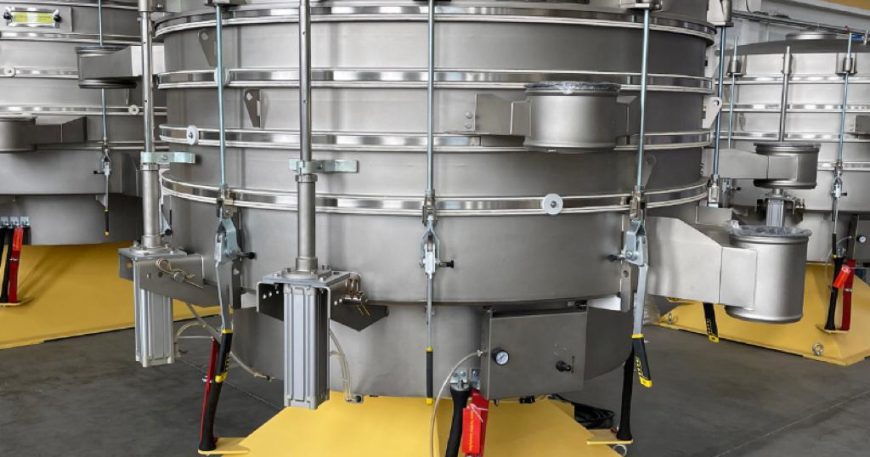
Good maintenance prevents unplanned downtime, quality loss and premature wear. A screening machine works under continuous mechanical load, so small deviations can quickly become larger problems if they are not detected in time.
Focus on preventive instead of reactive maintenance
Waiting until a screen mesh tears or a seal leaks is expensive. Preventive maintenance makes it possible to plan replacements at moments that suit the process.
For a stable installation, it is useful to link inspections to operating hours, product type and critical quality requirements.
Parts that need regular attention
Screen meshes, seals, clamps, vibration motors and spring elements are logical inspection points. Unusual noise, changed vibration behavior or product buildup in the frame are also clear warning signs.
Also check whether all connections still seal properly and whether material buildup occurs in places that can harm flow or hygiene.
- Check mesh tension and damage to the screen cloth.
- Inspect rubber parts and seals for wear.
- Monitor bearings, motor load and abnormal vibration.
Use a fixed maintenance frequency
A simple schedule with daily checks, weekly inspections and periodic deeper checks is often more effective than maintenance based on feeling.
This makes it easier to identify trends, such as a mesh wearing faster after a product change or a motor gradually requiring more load.
Maintenance is also process optimization
Maintenance does not only reduce failures; it also creates more consistent separation performance. A machine that is mechanically healthy maintains capacity and product quality much better.
For companies with high requirements for output and delivery reliability, maintenance is therefore a fixed part of process control, not only a task for the technical department.
Do you want to validate this for your own product? Contact VAAPRO to discuss your capacity, specification and process setup.
 English
 Nederlands
 Deutsch